Most Canadian mortgage brokers know they should reach out to their past clients more consistently. Most don’t, because the manual version of doing it is exhausting and the automated version usually feels generic.
The brokers who solve this problem and generate real deals from their book don’t do it through impressive volume. They do it through specificity, timing, and follow-up logic. Three variables most broker email sequences miss.
This post covers what actually works in Canadian mortgage broker client outreach, what doesn’t, and why the follow-up - the email that goes out when the first one gets no response - matters more than the first email.
The problem with generic outreach
The default broker outreach pattern looks something like this:
- Send every client a monthly newsletter.
- Send every client a birthday greeting.
- Send every client a rate update when rates move significantly.
- Send every client a renewal reminder in the month before their maturity date.
All of these are reasonable in principle. All of them, done generically across a full book, produce underwhelming results. The reasons are consistent:
Generic content produces generic response. A “rates dropped 25 basis points” email to 400 clients reads as a mass broadcast. The client who actually has a refinance-eligible file gets the same email as the client who funded three months ago at a fine rate. The eligible client can’t tell that this email applies to them specifically. They archive it.
Untimed content misses windows. An email about HELOCs in February lands in the inbox of a client whose renovation project already started in January. A renewal reminder two weeks before maturity is too late; the bank has already sent their letter and the client has already decided.
One-shot campaigns leave money on the table. A broker sends one email to 300 clients, gets a 2 percent response rate (six replies), congratulates themselves on the six conversations. What happened to the other 294 clients? Most didn’t see the email. Most who saw it didn’t act. And the broker doesn’t follow up - so the silent 294 stay silent.
The brokers who generate real deals from their outreach fix all three.
What works: specific, timed, sequenced
The outreach that converts past clients into active deals has three features.
Specific: addresses an actual opportunity for this client
“Your home in the Leslieville area has appreciated approximately 18% since you funded in 2021. Your current equity position supports a HELOC of approximately $180,000 if you’d like to discuss options for renovation, investment, or consolidation” beats “HELOCs are a great option for home equity.”
Specificity requires the broker to know each client’s situation well enough to personalize. That scale is the problem - a broker can’t manually personalize 400 emails. Revenue intelligence software that calculates per-client opportunities and then produces outreach referencing those specific numbers is how specificity scales.
Timed: lands in the window where the client can actually act
Rate-drop messaging to clients whose IRD penalty is too high to benefit is wasted. Renewal messaging after the bank’s letter has already arrived is late. HELOC messaging to clients who just did a renovation is irrelevant.
Good timing means the outreach fires when the math says the client has a real opportunity - when rates and balances have moved enough that their refinance crosses a profitability threshold, when their renewal window opens, when their equity reaches a HELOC-qualifying level. Continuous scanning makes this possible; quarterly manual reviews don’t.
Sequenced: follows up automatically when the first email doesn’t get a response
This is the one most broker outreach skips, and it’s arguably the most important.
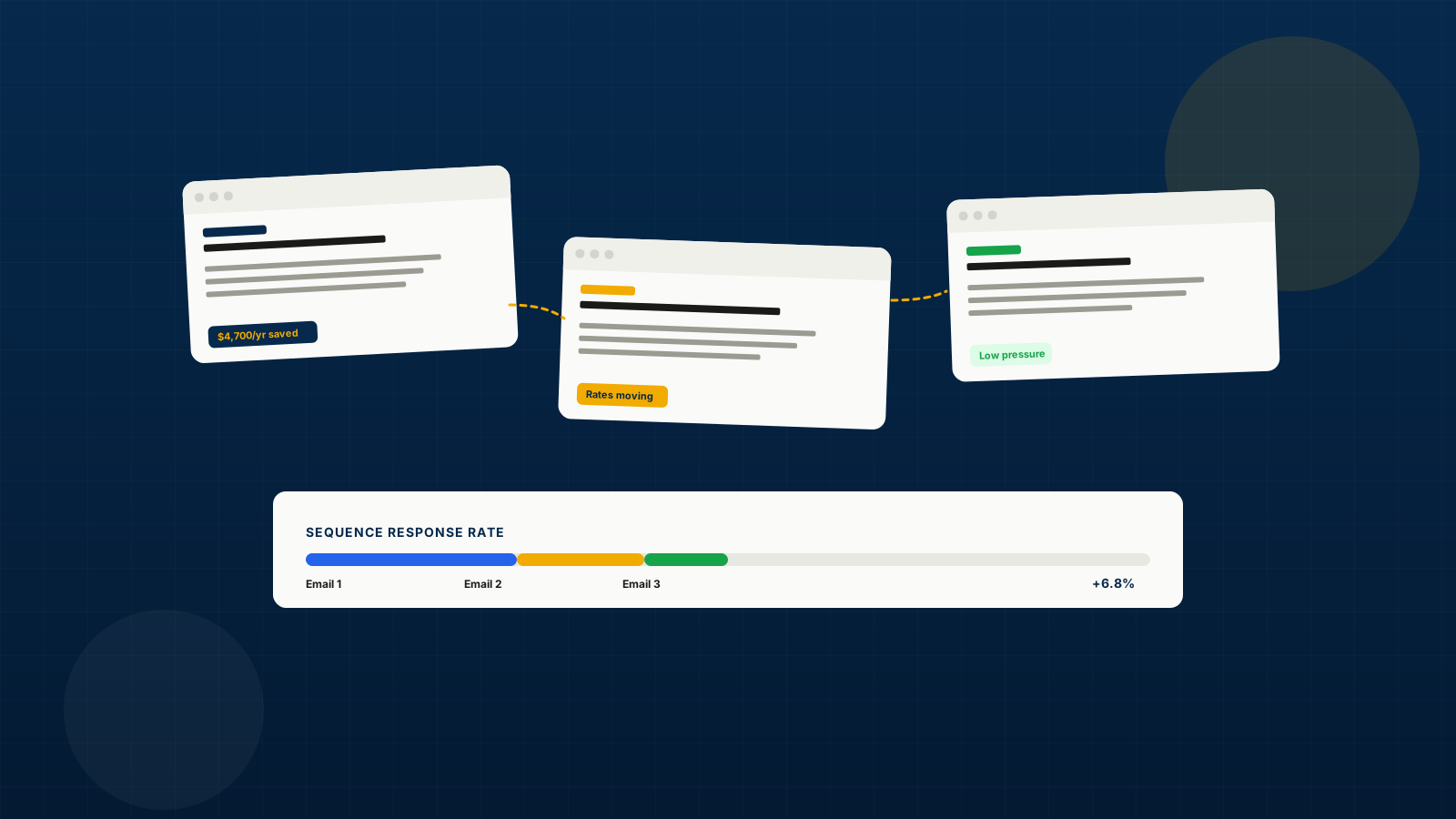
A single email produces 2-4 percent response rates in broker outreach. The second email in a sequence typically adds another 1-2 percent. The third adds another 1 percent. A three-email sequence can produce 4-7 percent response rates where a single email produced 2-4 percent - roughly doubling the opportunities generated from the same underlying list.
4-7%
response rate on a three-email outreach sequence to specific, opportunity-eligible clients. Single-email outreach produces 2-4 percent on the same list. Follow-up logic roughly doubles the deals generated.
Most brokers don’t send email three because they’re nervous about being annoying. The brokers who do send email three get more deals. The key is that each email in the sequence has a different angle rather than just restating email one.
Example three-email sequence for a refinance-eligible client:
Email 1 (Day 0): The opportunity. “I was reviewing your file and the math suggests you could save roughly $4,700 per year by refinancing at today’s rates. Here’s the calculation.” Attaches or links to the specific analysis.
Email 2 (Day 5): The urgency frame. “Rates have moved a little since we last talked - wanted to flag that the window on this refinance opportunity could narrow if rates continue to move. Happy to walk through the math whenever you have 15 minutes.”
Email 3 (Day 12): The low-pressure close. “Totally understand if now isn’t the right time. I’ll leave it at this unless you want to revisit. If your situation changes in the next 6 months, hit reply and I’ll re-run the numbers.”
Three emails, different angles, automatic cadence. The broker does not need to remember to send any of them. Software triggers the sequence, software stops it as soon as the client responds.
Why broker-branded matters
The outreach that converts comes from the broker’s own email address, not from a tool-branded domain.
“From: Sarah Chen, Your Mortgage Broker” converts. “From: Ownwell Engagement Bot” or “From: BrokerPlus Outreach” does not. The client relationship is with the broker, and every email that reinforces that relationship compounds; every email that introduces a third-party brand dilutes it.
This is why BrokerPlus never appears in client communications. Emails sent through the platform come from the broker’s own address, use the broker’s templates and signature, and look to the client like the broker wrote them personally. The automation is invisible to the recipient.
Same rule applies to reports. A branded home equity report showing the broker’s logo, contact info, and personal branding works. A report showing “Powered by BrokerPlus” doesn’t. The client doesn’t need to know there’s software involved.
Templates that work
The specific templates that convert for Canadian mortgage brokers share structural features:
Short. Under 150 words. Brokers often think longer emails demonstrate more effort; clients read shorter emails. If the email can be read in 15 seconds, it gets read.
Specific numbers. The annual savings figure, the available HELOC dollar amount, the exact maturity date. Numbers make the email feel personal. Vague references (“you may have opportunities”) read as marketing.
One ask. A single clear next step: reply to set up a call, click a link to see the full analysis, confirm their current situation. Emails with three competing calls-to-action convert worse than emails with one.
Personal sign-off. Actual name, phone number, email signature. Not a marketing footer with five social links.
Example template for a HELOC opportunity:
Hi [First Name],
Quick note - I was reviewing your file and noticed your home value has grown meaningfully since we last connected.
Based on your current equity position, you’d have access to approximately $[X] through a HELOC if you ever wanted to use it for renovation, investment, or consolidating higher-interest debt.
Not urgent. Just wanted to make sure you knew the option was there. Happy to walk through the math whenever.
[Broker Name]
[Phone] | [Email]
Short. Specific. One ask. Personal. That template converts better than a 400-word newsletter with nine links.
Templates that don’t work
Several patterns that reliably underperform:
“Just checking in.” No opportunity, no specific reason, no urgency. Produces near-zero response. The client reads it and thinks: “checking in on what?”
Rate market newsletters as outreach. Useful for relationship maintenance; not useful as a sales conversation starter. Rate movements affect clients differently. Generic rate update means nothing to a client who doesn’t know how it applies to their specific situation.
Birthday and anniversary emails. Nice touch. Don’t generate deals. Treat these as relationship maintenance, not outreach, and don’t count them in your response rate math.
Attachment-heavy emails. A 400-word email with a PDF attachment converts worse than a 150-word email with a single clear link. Friction kills conversion.
Asking for referrals in outreach to specific opportunities. Mixing a referral ask into an email about the client’s own refinance opportunity waters both down. Ask separately.
The technical stack
For brokers doing outreach at scale, the technical options are:
Do nothing. Most Canadian brokers are here. No systematic outreach, ad hoc phone calls when something comes up. Produces some deals from the brokers with strong memory and discipline. Leaves most of the revenue on the table.
Email marketing tools (Mailchimp, ActiveCampaign, HubSpot). Can run sequences, but the content is generic unless you manually personalize per-client. Doesn’t integrate with broker-specific data (IRD calculations, lender data, property values). Works for newsletter-style communication, not for opportunity-specific outreach.
CRM-based drip campaigns. Your mortgage CRM (BluMortgage, Velocity, etc.) can send triggered emails based on maturity dates and client anniversaries. Better than generic email marketing because the triggers are broker-specific. Still limited to broad categories rather than specific opportunity math.
Revenue intelligence with built-in outreach (BrokerPlus). Combines the per-client opportunity analysis with automated outreach. The outreach fires when the math identifies an opportunity, not on a calendar schedule. Follow-up sequences are built in. Emails come from the broker’s own address.
The revenue intelligence approach is the newest and the most effective for opportunity-specific outreach. CRM-based drip is adequate for renewal reminders. Email marketing tools are underpowered for broker needs. Doing nothing is the most common and the least productive.
Frequently asked questions
How many emails per month should I be sending to past clients?
For outreach specifically (opportunity-triggered messaging), zero to two per client per month is the right range. Most months, most clients should get no outreach because they don’t have an actionable opportunity. The few clients with live opportunities get one to two touches in the outreach sequence. For relationship maintenance (monthly homeowner reports, newsletters), that’s separate - one per month is standard.
What response rate should I expect?
For opportunity-specific outreach with proper timing and specificity, 4-8 percent response rate across a three-email sequence is a reasonable benchmark. For generic broadcast emails, 1-3 percent is typical. The difference is specificity and follow-up - a specific three-email sequence to 50 clients with real opportunities produces more conversations than a generic email to 400.
Can automated outreach hurt my relationship with clients?
Only if it’s bad. Automated outreach that’s specific, well-timed, and personally branded feels like the broker being proactively useful - most clients appreciate it. Automated outreach that’s generic, poorly timed, or obviously mass-produced feels like spam and erodes the relationship. The difference is execution quality, not automation per se.
What’s the unsubscribe risk?
Unsubscribes happen, and they’re fine - a client who unsubscribes wasn’t going to produce a deal anyway. Pay attention to the unsubscribe rate as a signal: over 2 percent on a specific sequence means the content isn’t landing, and you should revise.
How do I handle clients who respond with “not interested”?
Acknowledge, close the loop warmly, keep them on the list for future opportunities. “Totally understand, I’ll leave it at this unless something changes. Reach out any time.” Then set your system to not message this client on this topic for 6-12 months. They may become relevant again.
Should I personalize every email manually or use merge fields?
Merge fields (first name, specific dollar amount, specific opportunity) are what make automated outreach feel personal. A well-designed template with strong merge fields reads as personally written to most clients. Manual personalization produces marginally better results but doesn’t scale; for a book of 300+ clients, merge-field automation is the right answer.
What’s the single most important thing to get right?
Specificity. An email that references the client’s specific situation - their home, their mortgage, their equity, their actual dollar opportunity - converts multiple times better than an email that generically suggests they might have options. If you can only fix one thing, fix specificity.